REST in central nervous system tumors
DOI:
https://doi.org/10.18388/t9qmjg04Abstract
The transcription factor REST (RE1-silencing transcription factor) is a key regulator of neuronal gene expression, playing a role in normal brain development and in the pathogenesis of central nervous system (CNS) tumors. By binding RE1 sequences and recruiting repressive complexes, it participates in epigenetic gene silencing, controlling the processes of neurogenesis and cellular differentiation. In CNS tumors, REST exhibits context-dependent effects, most often acting as an oncogene.
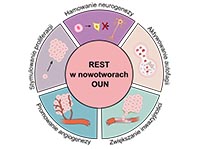
Deregulation of its expression promotes pro-tumor processes, such as maintaining tumor stem cell properties, inhibiting differentiation, proliferation and increased invasiveness, angiogenesis, adaptation to hypoxia, and shaping the tumor microenvironment. Accumulating evidence indicates its potential as a biomarker and therapeutic target, making REST a promising element of treatment strategies for CNS tumors.
Downloads
Published
Issue
Section
License
Copyright (c) 2026 Zuzanna Bieńkowska, Maciej Ołdak, Marta Maleszewska

This work is licensed under a Creative Commons Attribution 4.0 International License.
All journal contents are distributed under the Creative Commons Attribution-ShareAlike 4.0 International (CC BY-SA 4.0) license. Everybody may use the content following terms: Attribution — You must give appropriate credit, provide a link to the license, and indicate if changes were made, ShareAlike — If you remix, transform, or build upon the material, you must distribute your contributions under the same license as the original. There are no additional restrictions — You may not apply legal terms or technological measures that legally restrict others from doing anything the license permits.
Copyright for all published papers © stays with the authors.
Copyright for the journal: © Polish Biochemical Society.