Glutathione deficiency and disturbances of sulfur homeostasis in the pathophysiology of schizophrenia
DOI:
https://doi.org/10.18388/pb.2021_618Abstract
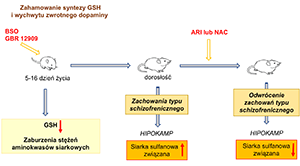
Schizophrenia is a mental illness characterized by positive and negative symptoms and cognitive function disorders. Animal models are used in studies of the pathophysiology of schizophrenia and in the search for new drugs. In one of the recently developed rat’s neurodevelopmental model, schizophrenic-like changes were induced by administration of buthioninesulfoximine (BSO) - an inhibitor of glutathione synthesis and a dopamine reuptake inhibitor - the compound GBR 12909 during the developmental period. Behavioral tests conducted on adult rats showed that deficits in social behavior and cognitive functions were observed in the model animals, and rats that received a combination of both compounds additionally showed positive symptoms. The usefulness of the developed model was tested by the effect of the antipsychotic drug aripiprazole and N-acetylcysteine. Behavioral tests showed that N-acetylcysteine reversed the changes in the animals' behavior similarly to aripiprazole. At the biochemical level, both drugs significantly reduced the elevated concentration of bound sulfane sulfur in the hippocampus of model rats. Recent studies indicate that in the neurodevelopmental pathophysiology of schizophrenia, disturbances in the homeostasis of sulfur compounds play an important role, which are corrected by the action of drugs.
Published
Issue
Section
License
Copyright (c) 2025 Magdalena Górny, Elżbieta Lorenc-Koci, Małgorzata Iciek

This work is licensed under a Creative Commons Attribution 4.0 International License.
All journal contents are distributed under the Creative Commons Attribution-ShareAlike 4.0 International (CC BY-SA 4.0) license. Everybody may use the content following terms: Attribution — You must give appropriate credit, provide a link to the license, and indicate if changes were made, ShareAlike — If you remix, transform, or build upon the material, you must distribute your contributions under the same license as the original. There are no additional restrictions — You may not apply legal terms or technological measures that legally restrict others from doing anything the license permits.
Copyright for all published papers © stays with the authors.
Copyright for the journal: © Polish Biochemical Society.